Clover vs Toast, a platform against a specialist.
Clover publishes a restaurant rate of 2.3% + 10¢, software from $89.95 a month and hardware from $1,799. Toast publishes software plans and no rate and no hardware price. The deeper difference is that Toast only does restaurants.
What this page settles.
Three questions, in the order most people ask them.
The short answer
Toast is the better restaurant system. Clover is the one that tells you the price.
Toast does nothing but restaurants, and it shows: coursing, kitchen display, handhelds, online ordering, delivery integrations, labour and scheduling are all built for the job rather than adapted to it. Clover is a general-purpose point-of-sale platform with a restaurant configuration, and it is a competent one, but it is not purpose-built in the same way.
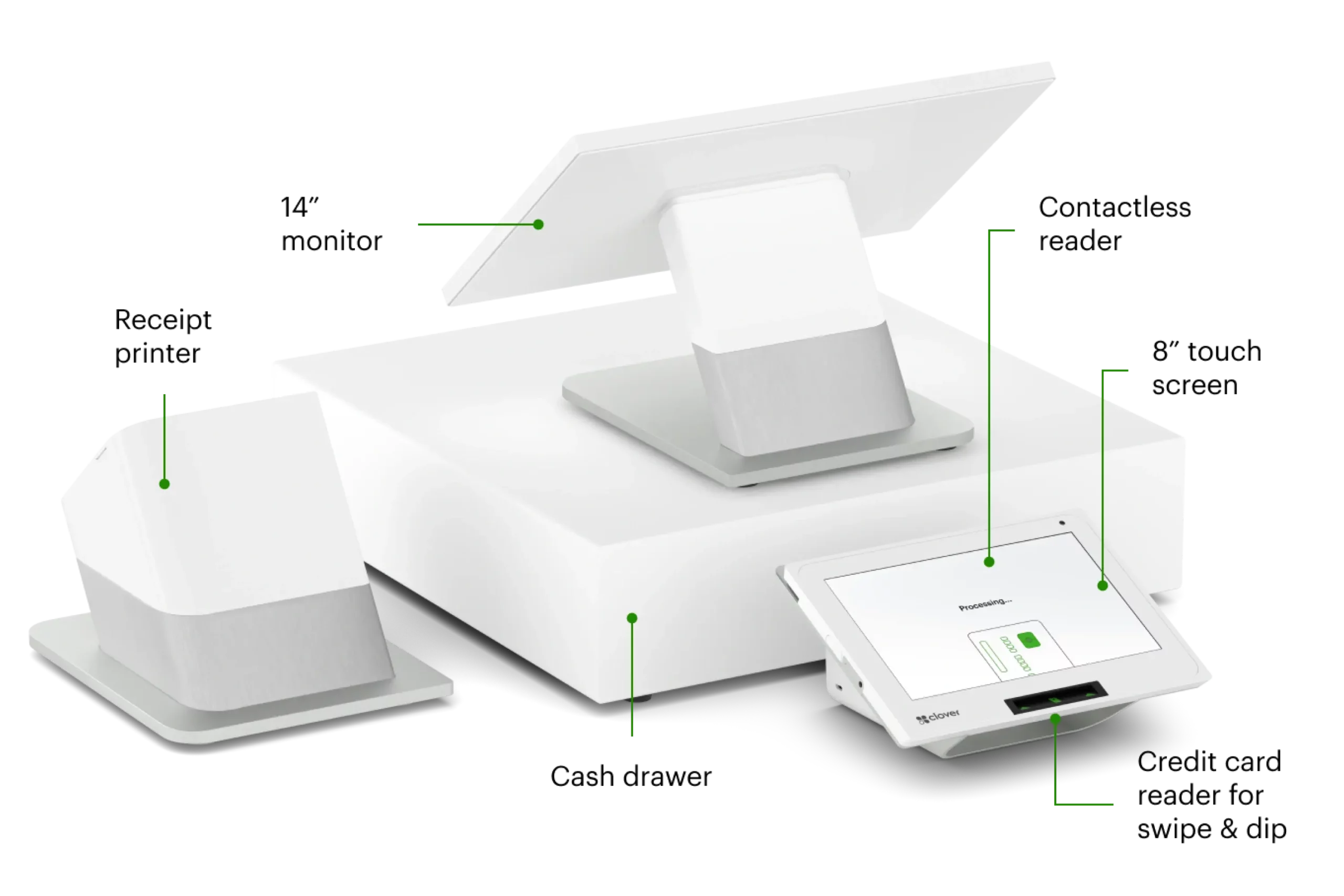
On price the positions reverse. Clover publishes, for a restaurant buying direct on clover.com: 2.3% + 10¢ card present, 3.5% + 10¢ keyed, software at $89.95, $109.90 or $129.85 a month, and hardware at $1,799, $2,548 or $4,447 outright — or $179, $239 or $354 a month over 36 months. Toast publishes software plans at $0, $69 and $69 plus $9 per employee, and nothing else.
The complication is that most Clovers are not bought direct. Clover is resold by hundreds of ISOs and banks, each setting its own rate, fees and term. If you are holding a Clover quote from a reseller, the published figures above are not what you will pay and are not a benchmark you can hold them to.
Published pricing, side by side
| Clover | Toast | |
|---|---|---|
| In person | 2.6% + 10¢ retail Starter plan bought on clover.com; 2.3% + 10¢ on Retail Growth and on all three restaurant plans |
Not published |
| Keyed | 3.5% + 10¢ | Not published |
| Online | Not published on the plan pages | Not published |
| Pricing model | Flat rate, when bought direct | Software published, processing quoted |
| Monthly | Retail: $0 on Starter hardware, $84.95/mo Standard, $104.90/mo Advanced. Restaurant: $89.95/mo, $109.90/mo, $129.85/mo. | $0, $69/mo, and $69/mo plus $9 per employee a month are the plan figures on the pricing page |
| Contract | Not published on the pricing pages | Not published |
| Monthly minimum | Not published | Not published |
| Funding | Not published on the pricing pages | Not published |
| Chargeback fee | Not published | Not published |
| Hardware | Retail: $349, $1,899 or $2,648 outright, or $16, $180 or $240 a month over 36 months. Restaurant: $1,799, $2,548 or $4,447 outright, or $179, $239 or $354 a month over 36 months. | Not published. The page says hardware and implementation costs vary, with 0% financing available by application. |
| Account type | Depends entirely on who sold it to you | Toast describes itself as a payment facilitator that partners with processors |
Clover: www.clover.com, www.clover.com — read 2026-10-08. Toast: pos.toasttab.com — read 2026-10-08.
Published prices change. These were read on the dates above and are list prices for a business buying direct — a quote you are given may differ, and should be compared as a quote rather than against a price list.
Clover, also published:
- Clover is a platform resold by hundreds of ISOs and banks. The rates above are Clover’s own direct online prices; a Clover bought from a reseller is priced by that reseller and can look nothing like this.
- The pricing pages say the prices shown are only available online
Toast, also published:
- Toast publishes software plan prices and does not publish a processing rate anywhere on its pricing page
- The plan figures are for new customers and single locations, and include the first hardware terminal subscription
Where they actually differ
Restaurant depth. Toast wins, and not narrowly, at the complex end — multi-area service, kitchen workflow, coursing and timing, delivery aggregation, labour management. Clover covers the common ground: table mapping, open tabs with card pre-authorization, bill splitting, QR order and pay, tipping.
Who you buy from. Toast sells direct. Clover sells direct and through a very large reseller channel. Buying direct means a published price and a known counterparty; buying through a reseller means a negotiated price, possibly a better one, and a contract to read carefully. Neither is automatically worse. The difference is that with Clover you have to establish which conversation you are in. Who is who in payments.
Hardware cost, and the financing. Clover publishes both the outright price and a 36-month monthly figure. Thirty-six months of financing on point-of-sale hardware is a lease in substance, and $354 a month for 36 months is $12,744 against $4,447 outright — the comparison that matters is the total, not the monthly. Toast publishes no hardware price and offers 0% financing by application. Buy or lease.
The term. Neither publishes a contract term on its pricing pages. Multi-year commitments are normal in restaurant point-of-sale. Get it in writing, along with what happens to the hardware if you leave. Agreement red flags.
Processing is locked to both. This is the expensive symmetry. Whichever you choose, you are committing your processing cost for the life of the system, which is why it has to be priced before the software decision rather than after. Choosing a restaurant POS.
Who each one suits
Toast suits a restaurant where the kitchen workflow is the operation — full service, coursing, several service areas, handhelds on the floor, serious delivery and online ordering volume.
Clover suits a bar, cafe, quick-service counter or simpler full-service restaurant, and particularly a business that wants to buy at a published price without a long negotiation. It also suits an operator who already has a good relationship with an ISO offering a Clover at a rate they have actually checked.
Neither suits a restaurant whose main problem is processing cost. Both bundle processing, both are flat-rate in their published forms, and at $80,000 a month in card volume the saving available from interchange-plus is larger than the software fee of either. The question that unlocks that saving is “which systems let me bring my own processor”, and it is a different question from this one.
What the comparison does not show
Clover’s published prices apply only to a direct purchase. Said plainly because it is the most common misreading of a Clover comparison. A resold Clover is priced by the reseller.
Neither price list includes implementation. Menu build, install, training, and the messy week of running two systems. Toast names implementation as a variable cost; Clover does not mention it. Both have one.
Toast’s rate is the whole unknown in this comparison. Ask for the rate, the per-item, every monthly fee, the term, the exit terms and the hardware total, in writing, before comparing anything.
Clover does not publish its funding timing, monthly minimum or chargeback fee. Toast publishes none of those either. Four things to get in writing from whichever you choose. Funding times.
How to settle it with your own numbers
Half of this comparison cannot be done from a web page, because Clover and Toast publishes no rate. So the comparison has to happen on your own numbers instead, and the figure that makes it possible is your effective rate: total fees for a month divided by total card volume for that month.
Get the Clover and Toast quote in writing, with the markup as a number, the per-item, and every monthly fee named individually. Apply all of it to your own volume, your own average ticket and your own card mix, add the monthly fees, and divide by volume. That single number is the only thing comparable to Toast’s published figures — or to anybody else’s. A quote that cannot be reduced to it is not a quote.
Comparing two quotes is the full method for an unpublished rate, and the calculator does the arithmetic once you have the figures.
What we charge
Interchange + 0.50% + 10¢ in person, interchange + 0.75% + 25¢ keyed, with no contract, no monthly fee and no monthly minimum.
If you are holding a quote from Clover or Toast, send it to us with one page of a statement. We will reduce the quote to an effective rate at your own volume and put it next to Toast’s published figures and ours, so you are comparing three numbers of the same kind instead of a price list against a sales conversation.
While we are on the subject
Is Clover cheaper than Toast?
Clover publishes a rate and hardware prices; Toast publishes neither, so the comparison depends on Toast’s quote. Clover’s published software cost is higher than Toast’s published software cost.
Is Toast better than Clover for restaurants?
On restaurant-specific capability, generally yes — it is purpose-built and Clover is a general platform with a restaurant configuration. Whether that capability is worth its total cost depends on how complex your service is.
Should I buy Clover direct or from a reseller?
Direct gives you a published price. A reseller may beat it or may not, and brings a contract, a term and possibly a hardware lease. Compare the reseller’s quote against clover.com’s published prices before signing.
Can I move my Clover hardware to another processor?
Usually not. Clover hardware is normally locked to the party that deployed it, so switching processors generally means new hardware.