On a street corner, the connection is the whole problem.
Mobile trading removes every assumption a merchant services quote is built on. What matters is cellular connectivity, battery life and the per-transaction fee — in that order — and the rate comes a distant fourth.
What this page settles.
Three questions, in the order most people ask them.
The three things that actually matter
A merchant services quote is written for a business with a counter, mains power and a broadband line. A food truck has none of those, and the things that decide whether you can trade are not on the quote at all.
Cellular connectivity. Not venue wi-fi. A shared network at a busy market is overloaded exactly when you have a queue, and a trader who cannot take cards at the lunch rush has lost the day. Any device you rely on needs its own mobile data.
Battery. Everything you use runs on a battery, including the thing you are taking payment on, and the failure is always at 2pm on the busiest day. A power bank is not optional equipment.
The per-transaction fee. Mobile food is a small-ticket trade. At an $11 average, a 10¢ per-item fee is 0.91% of the sale and a 30¢ fee is 2.73%. That gap is bigger than any rate difference anyone will quote you. Small-ticket fees.
The rate comes fourth, and it is the only one most quotes discuss.
Why a phone is usually the right answer
Modern phones read contactless cards and wallets using their own hardware. No reader, no pairing, no second battery, no extra device to lose.
The economics are good. A tap is a card-present transaction and is priced as one — the cheapest interchange treatment available. For a trader who would otherwise be keying cards or carrying a reader, that is both cheaper and simpler. Tap to pay on a phone.
The limits are specific and worth knowing. It reads contactless cards and wallets, and it cannot read a chip card that has to be inserted. Most cards tap and most customers tap by default, but not all, and a customer whose card will not tap cannot pay you.
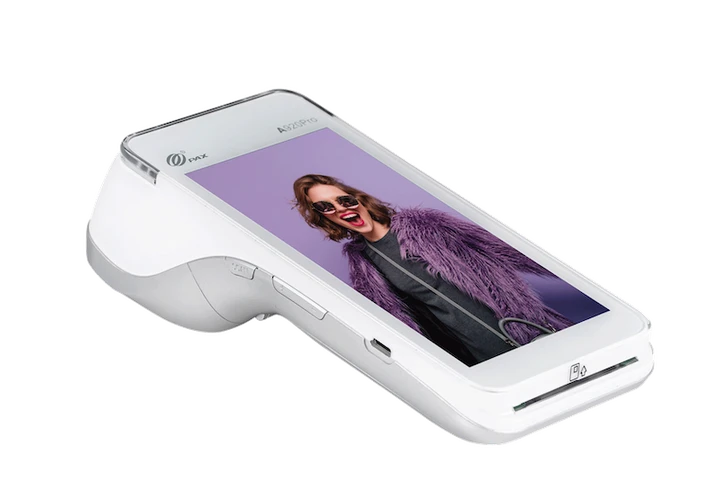
Which is why the sensible mobile setup is a phone plus a small reader. The phone handles nearly everything; the inexpensive Bluetooth or cellular reader covers the chip-insert cases and acts as a backup when the phone dies. Buy the reader rather than leasing it — at this price a lease is absurd. Buy or lease.
There is no paper receipt, which for food service is almost never a problem and occasionally is.
The per-transaction fee
Worth doing the arithmetic properly because it is the number that decides your cost.
Take a truck doing $9,000 a month across 820 transactions — an $11 average ticket.
At 10¢: $82 a month in per-item fees, which is 0.91% of volume.
At 15¢: $123, which is 1.37%.
At 30¢: $246, which is 2.73%.
The spread between the best and worst of those is 1.82% of your revenue, which is more than most merchants’ entire markup. And none of it appears in a conversation about rates.
Then add the percentage. A flat 2.6% plus 15¢ on an $11 ticket is a real cost of 3.97%. Interchange-plus with regulated debit passed through does better here than almost anywhere, because this trade is debit-heavy and regulated debit interchange is capped and low. Debit versus credit cost.
And watch the fixed monthly fees, which are the other thing that punishes a small seasonal business. A monthly minimum, a statement fee and a PCI fee are the same dollars in February as in July. On a trader doing $2,000 in a winter month, $50 of fixed fees is 2.5% on its own. Insist on none. Monthly minimum and small fees.
Tips
Mobile food is a tipping trade and the mechanics matter.
Tips are volume. A $12 order with a $2 tip authorises $14 and is processed on $14. You pay on the tip. There is no way around it and it is worth knowing so your effective rate does not confuse you later. Restaurant processing.
Prompt on the screen, at the point of payment. Tip prompting works on phones and readers alike, and a prompt collects more than a jar does.
Avoid tip adjustment if you can — the flow where you authorise one amount and add the tip later. On a mobile setup it is unnecessary complexity, and an adjusted amount settling outside the authorisation window causes downgrades. Take the tip at the point of sale and settle once. Batch cutoff times.
Trading at events and markets
Five practical things.
Never rely on the event’s wi-fi. Already said, worth repeating, it is the single most common failure.
Check signal at the pitch before the event, not on the morning. Some sites are dead zones and some are only dead when ten thousand people arrive.
Have a second way to take money. A phone plus a reader is two; two devices on the same dead network is one.
Charge everything the night before, and bring a power bank.
Think hard before relying on offline mode. Taking payments the processor has not approved means every decline is your loss, and at an event you will never see the customer again. Caps and limits apply. A cellular connection is the right fix. Offline mode.
What to look at on a quote
The per-transaction fee, as a percentage of your own average ticket. First, always.
No monthly fee, no monthly minimum, no annual fee. For a seasonal business these are worse than a slightly higher rate.
No contract and no termination fee. You may not be trading in eighteen months, or you may be trading somewhere else entirely. Agreement red flags.
Hardware bought, never leased. A four-year lease on a $150 reader is the worst deal in this industry and it is routinely offered to new mobile traders. Equipment lease fees.
Cellular connectivity, and what it costs per month.
Next-day funding, because cash flow on a mobile business is week to week. Funding times.
What we charge
Interchange + 0.50% + 10¢ in person, interchange + 0.75% + 25¢ keyed, with no contract, no monthly fee, no monthly minimum and no termination fee. Hardware sold outright, never leased.
For a new truck or stall we will sometimes tell you to start on a flat-rate app with a phone and come back when your volume justifies anything more. That is a smaller sale for us and it is the right answer often enough to be worth saying first.
While we are on the subject
What is the best card reader for a food truck?
Usually a phone with tap to pay, plus a small reader for chip cards that will not tap. Both need cellular rather than venue wi-fi.
Can I rely on event wi-fi?
No. Shared wi-fi at a busy event is the most common reason mobile traders cannot take cards, and it fails exactly when you are busiest.
Do I need a contract for a seasonal business?
No, and you should refuse one. Monthly fees and minimums are particularly bad for a business that trades part of the year — you pay them in the dead months too.
Does a tip count as volume?
Yes. The tip is part of the authorised amount, so it is processed like the rest of the sale.