Square vs Clover, and the reseller problem.
Bought direct from clover.com, Clover's card-present rate is lower than Square's and its software costs $85 to $130 a month. Bought from a reseller — which is how most Clovers are sold — the rate is whatever that reseller quoted you, and the published figures are irrelevant.
What this page settles.
Three questions, in the order most people ask them.
The short answer
If you are buying direct from clover.com, Clover’s card-present rate is lower and its software costs more. Clover’s retail Starter plan is 2.6% + 10¢; Retail Growth is 2.3% + 10¢ and costs $84.95 a month. Square’s free plan is 2.6% + 15¢ with no software fee at all. On a $40 ticket the 5¢ difference in the per-item is 0.125% — real, and smaller than the software fee at low volume.
If you are being sold a Clover by anyone other than Clover, none of that applies. Clover is a point-of-sale platform resold by hundreds of ISOs, agents and banks. Each of them sets its own processing rate, its own monthly fees, its own term and its own hardware arrangement. “What does Clover cost?” has no answer until you know who is selling it to you — and the published figures on this page are not a benchmark you can hold a reseller to.
That is the whole comparison. Square has one price list. Clover has one price list and several hundred actual prices.
Published pricing, side by side
| Square | Clover | |
|---|---|---|
| In person | 2.6% + 15¢ tapped, dipped or swiped on the free plan; 2.5% + 15¢ on Plus, 2.4% + 15¢ on Premium |
2.6% + 10¢ retail Starter plan bought on clover.com; 2.3% + 10¢ on Retail Growth and on all three restaurant plans |
| Keyed | 3.5% + 15¢ | 3.5% + 10¢ |
| Online | 3.3% + 30¢ 2.9% + 30¢ on Plus and Premium |
Not published on the plan pages |
| Pricing model | Flat rate | Flat rate, when bought direct |
| Monthly | $0 on the free plan; $49/mo per location (Plus); $149/mo per location (Premium) | Retail: $0 on Starter hardware, $84.95/mo Standard, $104.90/mo Advanced. Restaurant: $89.95/mo, $109.90/mo, $129.85/mo. |
| Contract | No contract. The page says “no hidden fees or locked-in contracts. Cancel or switch anytime.” | Not published on the pricing pages |
| Monthly minimum | Not stated | Not published |
| Funding | Next business day free; instant transfer for a fee | Not published on the pricing pages |
| Chargeback fee | Not published on the pricing page | Not published |
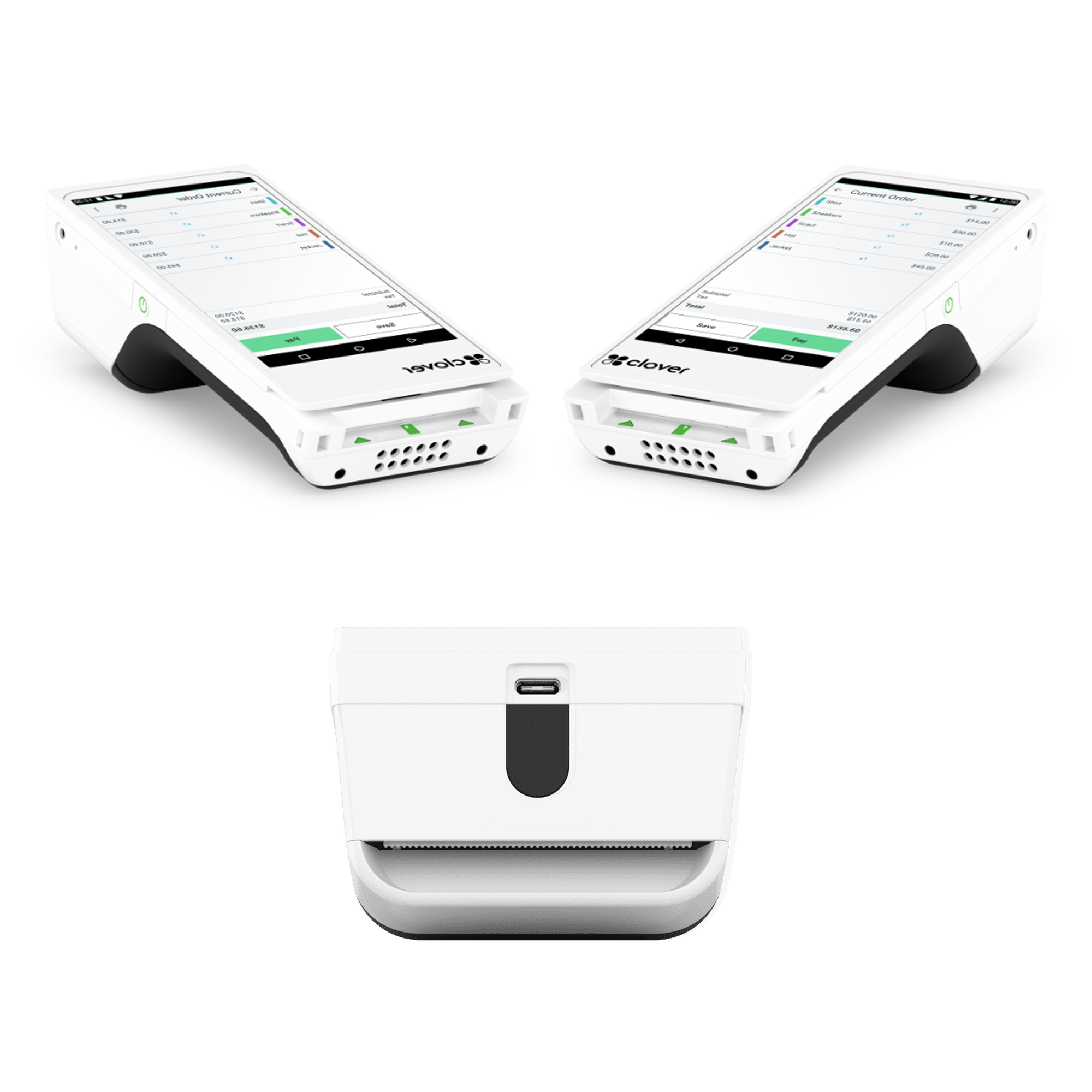
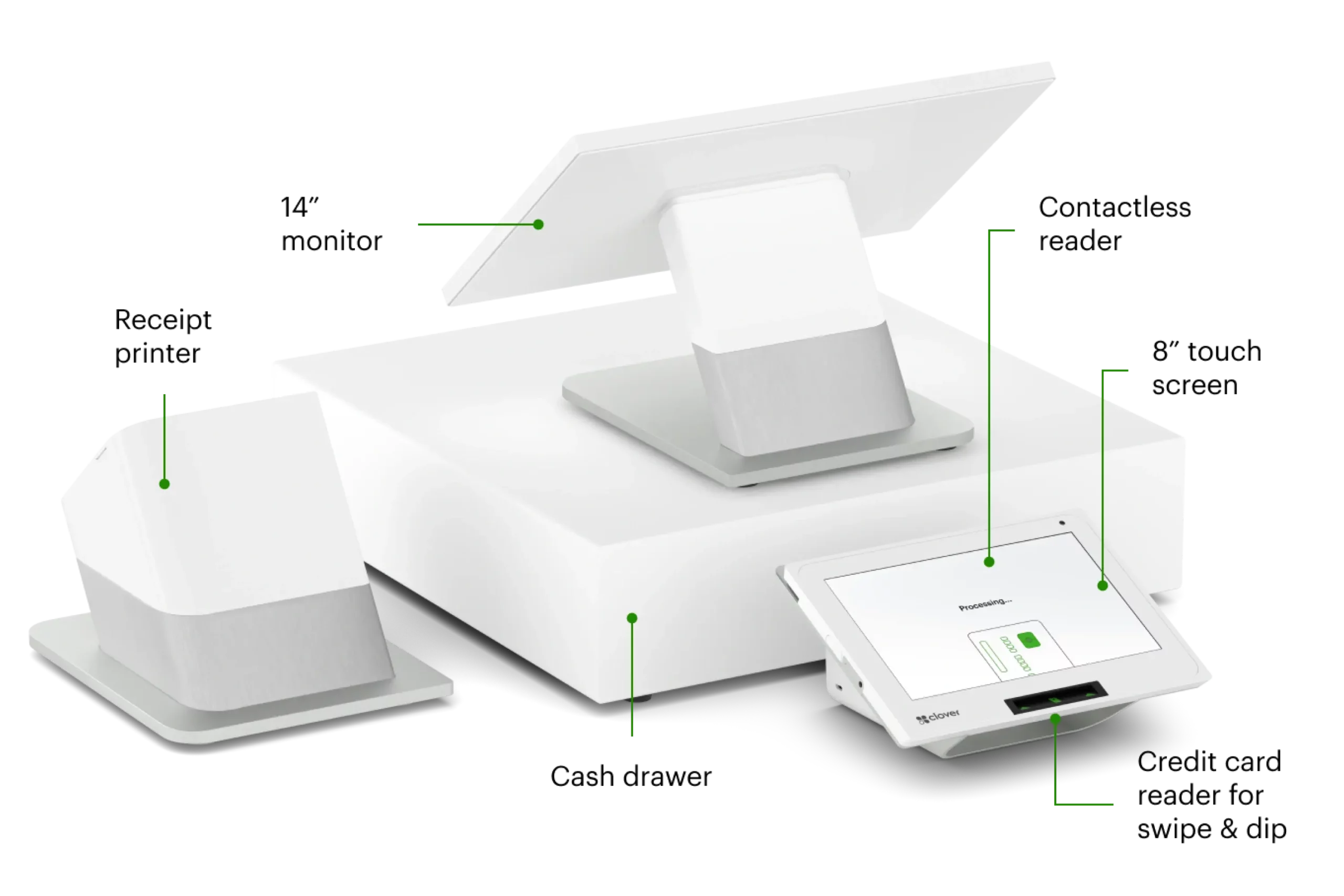
| Hardware | Sold outright; prices on a separate page | Retail: $349, $1,899 or $2,648 outright, or $16, $180 or $240 a month over 36 months. Restaurant: $1,799, $2,548 or $4,447 outright, or $179, $239 or $354 a month over 36 months. |
| Account type | Aggregator (sub-merchant under Square) | Depends entirely on who sold it to you |
Square: squareup.com — read 2026-10-08. Clover: www.clover.com, www.clover.com — read 2026-10-08.
Published prices change. These were read on the dates above and are list prices for a business buying direct — a quote you are given may differ, and should be compared as a quote rather than against a price list.
Square, also published:
- ACH via invoice 1%, $1 minimum
- Afterpay 6% + 30¢
- EBT 1.8% + 5¢
- Custom pricing available above $250,000 a year
Clover, also published:
- Clover is a platform resold by hundreds of ISOs and banks. The rates above are Clover’s own direct online prices; a Clover bought from a reseller is priced by that reseller and can look nothing like this.
- The pricing pages say the prices shown are only available online
Where they actually differ
The software fee. Square’s free plan is genuinely $0 a month and takes payments properly. Clover’s retail plans run $84.95 and $104.90 a month, and restaurant plans $89.95 to $129.85. Over a year that is $1,000 to $1,550 of software against zero, which at most small-business volumes is larger than the rate difference.
Worth being fair about: Clover’s software does more. Whether it does more that you will use is the terminal-or-POS question, and it is the question to settle before this one.
The hardware. Clover publishes outright prices — $349, $1,899 or $2,648 for retail; $1,799 to $4,447 for restaurant — and 36-month financing at $16 to $354 a month. Thirty-six months of financing on a point-of-sale system is a lease in substance, and the total is the number to look at rather than the monthly. Square sells readers and stands outright.
The account. Square is an aggregator: you are a sub-merchant under Square’s master account, not underwritten in your own right. A Clover bought from an ISO usually comes with your own underwritten merchant account. That difference does not show up until something goes wrong, and then it shows up sharply. Merchant account versus aggregator.
What happens when you want to leave. Square you stop using. A Clover from a reseller may come with a term, an early termination fee and a hardware lease on a separate schedule, and the Clover hardware itself is usually locked to whoever deployed it. Can I keep my terminal.
Neither lets you bring your own processor. This is the symmetry people miss. Square is Square’s processing or nothing. A Clover is locked to the processor whose reseller sold it to you. Either way you are buying a system and a processing relationship together, which is exactly the clause to price before you sign. Choosing a retail POS.
Who each one suits
Square suits a business that wants to start today with no software fee, no underwriting, no term and no negotiation; a business whose volume is low enough that a flat rate is fair; and anyone who would rather have one price list they can read in a minute than a quote they have to interrogate.
Clover suits a business that needs the point-of-sale software — real inventory, table service, staff management, the integrations — and either buys direct at the published price or gets a reseller quote it has actually checked.
Neither suits a business doing serious volume on a flat rate. Above roughly $25,000 to $40,000 a month in card volume, depending on your card mix and average ticket, interchange-plus tends to win and keeps winning as you grow. The honest version of this comparison at that volume is “neither of these, and here is why”. Flat rate versus interchange-plus.
What the comparison does not show
Clover’s published rate is not most people’s Clover rate. Said once more because it is the single most important fact on this page. If you are holding a Clover quote from an ISO, compare that quote — not clover.com’s price list.
Neither published rate tells you your cost. Both are flat rates, which means they are an average across your card mix. A business whose customers carry mostly debit is subsidising one whose customers carry premium rewards cards, and neither can tell. What rewards cards cost and debit versus credit.
The per-item matters more than it looks at small tickets. Square’s 15¢ against Clover’s 10¢ is 0.125% of a $40 sale and 0.5% of a $10 sale. If you run a coffee counter, that gap is the comparison. Where small tickets hurt.
Clover does not publish its contract terms, its funding timing, its monthly minimum or its chargeback fee on the pricing pages. Square publishes some of that and not all of it. Both gaps are things to get in writing before you commit.
How to settle it with your own numbers
Half of this comparison cannot be done from a web page, because Clover publishes no rate. So the comparison has to happen on your own numbers instead, and the figure that makes it possible is your effective rate: total fees for a month divided by total card volume for that month.
Get the Clover quote in writing, with the markup as a number, the per-item, and every monthly fee named individually. Apply all of it to your own volume, your own average ticket and your own card mix, add the monthly fees, and divide by volume. That single number is the only thing comparable to Square’s published figures — or to anybody else’s. A quote that cannot be reduced to it is not a quote.
Comparing two quotes is the full method for an unpublished rate, and the calculator does the arithmetic once you have the figures.
What we charge
Interchange + 0.50% + 10¢ in person, interchange + 0.75% + 25¢ keyed, with no contract, no monthly fee and no monthly minimum.
If you are holding a quote from Clover, send it to us with one page of a statement. We will reduce the quote to an effective rate at your own volume and put it next to Square’s published figures and ours, so you are comparing three numbers of the same kind instead of a price list against a sales conversation.
While we are on the subject
Is Clover cheaper than Square?
On published direct prices, Clover’s card-present rate is lower and its software fee is much higher. Which wins depends on your volume: at low volume Square’s $0 software usually beats Clover’s lower rate, and the crossover moves with your monthly card total.
Can I use my own processor with Clover?
Not freely. A Clover is tied to the processor whose reseller deployed it, and the hardware is normally locked to them. That is the clause to settle before buying, not after.
Why do Clover quotes vary so much?
Because Clover is a platform sold through hundreds of independent resellers, each setting their own rate, fees and term. There is no single Clover price.
Can I move a Clover to a new processor?
Usually not. Clover hardware is normally locked to the deploying party, and most merchants switching away from a resold Clover end up buying new hardware.