Clover's fees, and why yours may be different.
Bought on clover.com, a Clover costs 2.3% to 2.6% + 10¢ with software from $84.95 a month and hardware from $349. Bought from an ISO — which is how most Clovers are sold — it costs whatever that ISO quoted, and the published figures are not a benchmark.
What this page settles.
Three questions, in the order most people ask them.
What it actually is
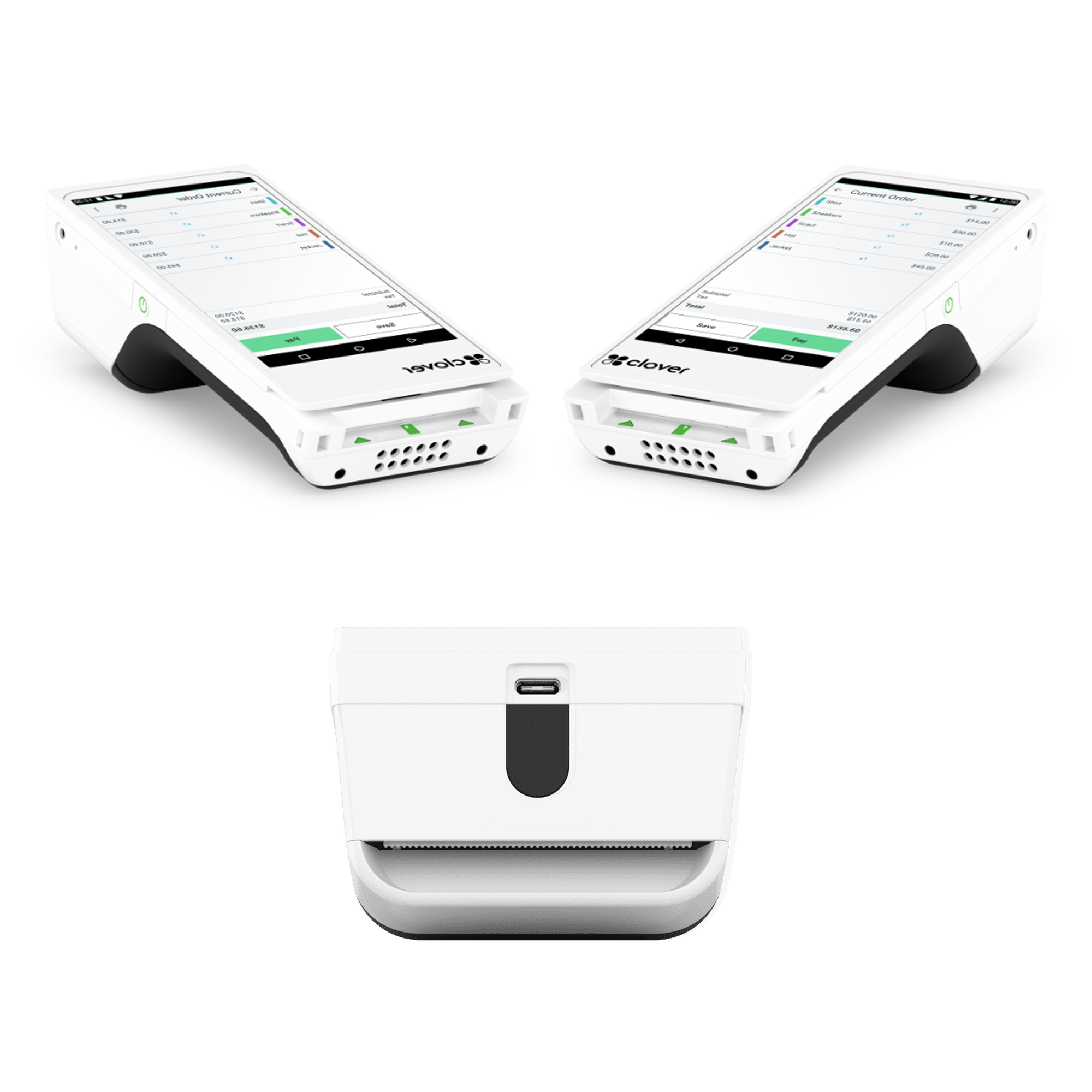
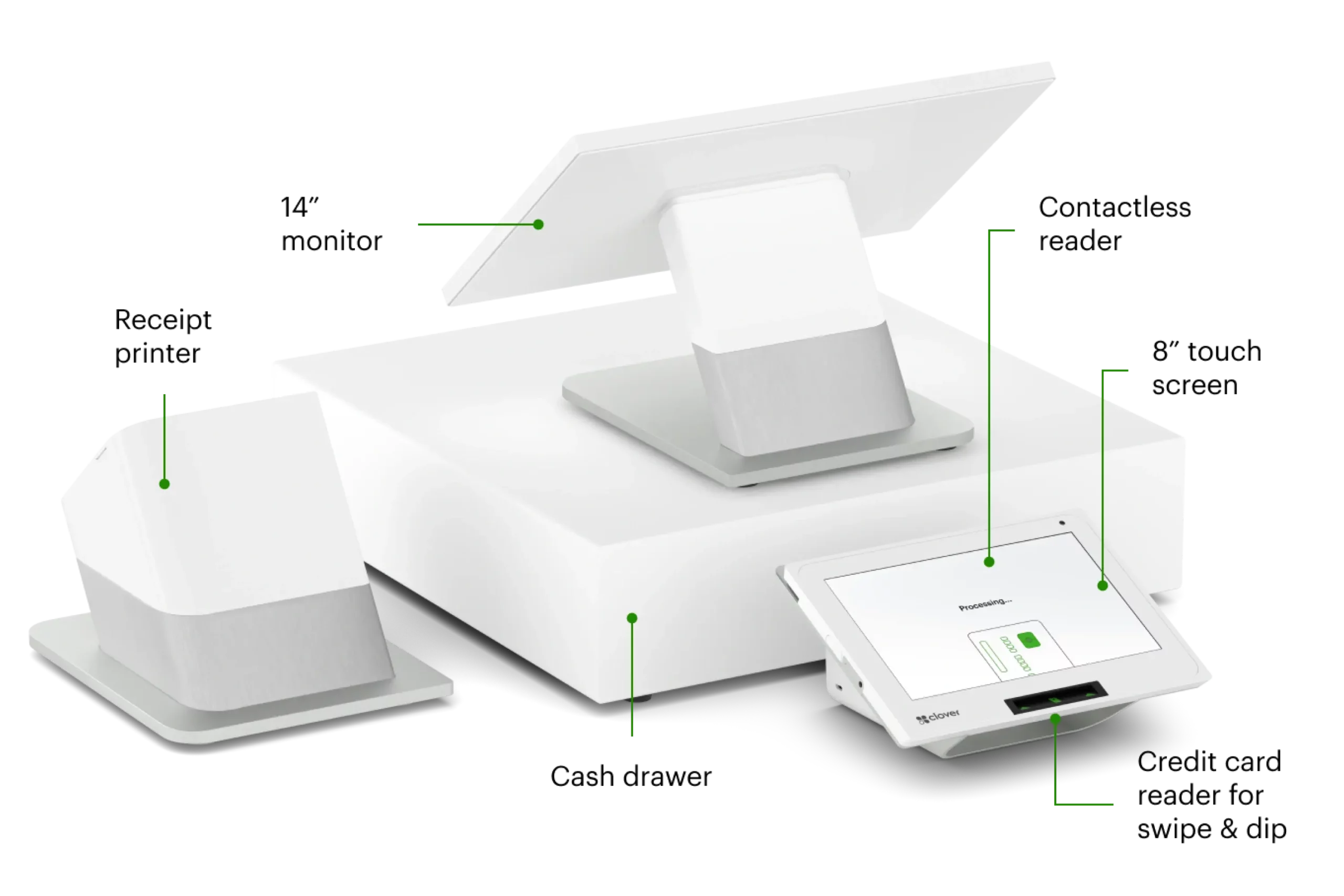
Clover is a point-of-sale platform owned by Fiserv. It is a family of hardware — countertop stations, handhelds, a compact terminal, a kiosk — running Clover’s own software, with an app marketplace on top.
The thing that makes Clover different from almost every other name in this market is how it is sold. Clover sells direct on clover.com at published prices. It is also resold by hundreds of ISOs, agents and banks, each of which sets its own processing rate, its own monthly fees, its own contract term and its own hardware arrangement.
So “what does Clover cost” has no single answer. It has a published answer, which applies to a direct purchase, and several hundred actual answers. If someone is quoting you a Clover, you are not being quoted the figures on this page, and holding them to these figures will not work. Who is who in payments.
Every published price
| Clover | |
|---|---|
| Pricing model | Flat rate, when bought direct |
| In person | 2.6% + 10¢ retail Starter plan bought on clover.com; 2.3% + 10¢ on Retail Growth and on all three restaurant plans |
| Keyed | 3.5% + 10¢ |
| Online | Not published on the plan pages |
| Monthly | Retail: $0 on Starter hardware, $84.95/mo Standard, $104.90/mo Advanced. Restaurant: $89.95/mo, $109.90/mo, $129.85/mo. |
| Contract | Not published on the pricing pages |
| Monthly minimum | Not published |
| Funding | Not published on the pricing pages |
| Chargeback fee | Not published |
| Hardware | Retail: $349, $1,899 or $2,648 outright, or $16, $180 or $240 a month over 36 months. Restaurant: $1,799, $2,548 or $4,447 outright, or $179, $239 or $354 a month over 36 months. |
| Account type | Depends entirely on who sold it to you |
Clover publishes these at www.clover.com, www.clover.com. Read 2026-10-08.
Also published:
- Clover is a platform resold by hundreds of ISOs and banks. The rates above are Clover’s own direct online prices; a Clover bought from a reseller is priced by that reseller and can look nothing like this.
- The pricing pages say the prices shown are only available online
The blanks are the part most people came for, and they are blanks rather than omissions: where that table says a figure is not published, Clover does not publish it. We read Clover’s own pages rather than taking a number from a review site, and a number we cannot source we do not print.
Published prices change. These are list prices for a business buying direct, read on the date above, and a quote you are given may differ.
What it costs in practice
Take the published direct prices and a retail business with a $45 average ticket.
Retail Starter at 2.6% + 10¢, $0 software, hardware $349. On $30,000 a month (667 transactions): $780 + $66.70 = $846.70, an effective rate of 2.82%.
Retail Growth at 2.3% + 10¢, $84.95 software. Same volume: $690 + $66.70 + $84.95 = $841.65, an effective rate of 2.81%.
Those are almost identical, which is the useful finding: the lower rate on the higher plan roughly pays for the software at $30,000 a month, and above that the higher plan wins. At $60,000 a month, Growth is about $150 a month cheaper than Starter despite the software fee.
The hardware is the bigger number in year one. $349 for a compact terminal, $1,899 or $2,648 for retail stations, $1,799 to $4,447 for restaurant configurations. The 36-month financing figures look small monthly and are not small in total — $354 a month for 36 months is $12,744 against $4,447 outright. Buy or lease.
What it is good at
It publishes prices at all, which puts it ahead of Toast, Lightspeed, NRS and the entire traditional end of the market. Who publishes and who does not.
The hardware is good and the range is wide. Countertop, handheld, compact, kiosk, customer-facing display, and they work together. For a business that wants real point-of-sale hardware rather than a tablet on a stand, this is a genuine strength.
The app marketplace is a real advantage. Third-party apps for scheduling, loyalty, inventory, accounting and trade-specific workflows mean a Clover can be configured for a lot of different businesses without custom development.
The direct rate is competitive. 2.3% + 10¢ card present is better than Square’s published rate, and the keyed rate of 3.5% + 10¢ is slightly better too.
It is everywhere, which means support, replacement hardware and people who know the system are easy to find.
Where it costs you
The reseller lottery. This is the main one. Two businesses with identical Clover systems can pay rates half a percent apart, one on month-to-month and one on a four-year term with a hardware lease. Nothing about the Clover tells you which you have. The only defence is reading the agreement you are being offered. Agreement red flags.
The software fee. $84.95 to $129.85 a month is $1,019 to $1,558 a year, and the question of whether you need the software is worth settling before the question of which system. Terminal or POS?
The financing. Thirty-six months on hardware is a lease in substance, and the published monthly figures make a $12,744 total look like $354.
Hardware lock. Clover hardware is normally locked to the processor whose reseller deployed it. Switching processors generally means new hardware, which is a real switching cost and is why the processing decision has to be made before you buy. Can I keep my terminal.
What is not published. The contract term, the funding timetable, the monthly minimum and the chargeback fee appear nowhere on the pricing pages. Four things to get in writing.
Who it suits, and who it does not
Clover suits a business that genuinely needs point-of-sale software and wants proper hardware rather than a tablet — a shop with stock, a restaurant with table service, a business with multiple staff and real reporting needs. Bought direct at the published price, it is a straightforward and competitive offer.
Clover suits it particularly well if the app marketplace solves a trade-specific problem you would otherwise pay for separately.
Clover does not suit a business that only needs to take payments — a terminal is cheaper, simpler and easier to leave. It also does not suit anyone being quoted by a reseller they have not checked, or a business that expects to shop its processing later, because the hardware lock makes that expensive.
If you are being quoted a Clover: get the rate, the per-item, every monthly fee, the term, the exit cost and the hardware arrangement in writing, and compare that quote against clover.com’s published prices before signing. Comparing two quotes.
What we charge
Interchange + 0.50% + 10¢ in person, interchange + 0.75% + 25¢ keyed, with no contract, no monthly fee and no monthly minimum.
Because Clover does not publish a rate, the only way to compare it to anything is to get its quote in writing and reduce it to an effective rate at your own volume. Send us the quote and a page of a statement and we will do that — including when the quote turns out to be better than ours.
While we are on the subject
Why do Clover quotes vary so much?
Because Clover is a platform resold by hundreds of independent ISOs and banks, each setting its own rate, fees and contract term. There is no single Clover price.
Is it cheaper to buy Clover direct?
Direct gives you a published price you can check. A reseller may beat it or may not — compare the quote against clover.com before signing either way.
Can I move a Clover to a different processor?
Usually not. Clover hardware is normally locked to the party that deployed it, so switching generally means new hardware.
Does Clover require a contract?
Its pricing pages publish no term. A resold Clover’s term is whatever the reseller’s agreement says, which is why that document has to be read before signing.